Showing posts with label Traditional Japanese Weapons. Show all posts

Saturday, June 26, 2010

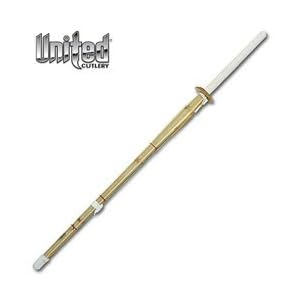
Kendo Bamboo Shinai Practice Sword

Kendo Bamboo ShinaiImproved your martial arts skills! This professional practice sword is designed for rigorous training. This item features solid bamboo construction with a leather wrapped grip and tip

This is an awesome practice shinai sword.It is very well made and easy to use.When I was looking for a shinai on here I was suprised to find one like this at a very good price.

Most of them I have come across on here are mostly about 20 dollars or more.So this is really an excellant deal and I garentee you will be happy with how well made this shinai

Monday, March 22, 2010

Wakizashi 脇差

Wakizashi 脇差
Wakizashi 脇差


Wakizashi is the substitution of weapons Edo period Japanese samurai past. Because the Japanese Samuari more likely to use the katana, spears, arrows than wakizashi. Actually wakizashi is a "sword" but more so in short, recognized as a Japanese samurai tradition pisau.Dalam, wakizashi is used to commit seppuku suicide by sticking to his stomach wakizashi. Seppuku done if the samurai could not fulfill his duty

Sunday, February 21, 2010

Japanese Sword from Late Kamakura

samurai-japan
Late Kamakura

Tachi at the end of the Kamakura period have developed into magnificent Sword. There are two types: one is wide throughout its length and the point section is the same as mid- Kamakura period kissaki, but slightly extended. The other is quite slender and similar in appearance to the late Heian, early Kamakura shapes. However, when you look further along the blade the shape has changed; the curvature has moved further along the blade. During this period notare-gunome hamon appeared. It is said that in Sagami province Goro Nyudo Masamune perfected the production of nie-deki blades.

Japanese Sword from Mid-Kamakura

Samurai-japan
Mid-Kamakura

At the zenith of the warrior class’s power during the Kamakura period, the blade’s kasane becomes thick, the mihaba becomes wide and they take on magnificent tachi shape. There is not much difference between the size of the moto-haba and the saki-haba. The blade still has koshi-zori, but the center of the curvature has moved further along the blade. The kissaki has become a compact chu-kissaki (ikubi). The hamon has developed into a flowing gorgeous choji-midare. Also around this time, tanto production appears.

Saturday, February 20, 2010

Japanese Sword Late Heian to Early Kamakura


From the late Heian period and the early Kamakura period (1185-1333) we can see the Japanese sword as we know it: shinogi-zukuri (ridgeline) construction, with a wide base, narrowing acutely towards the small point section (ko-kissaki). They are quite slender blades with the curvature concentrated between the handle and base. This shape is called koshi-zori. From midway towards the point there is very little curvature. These blades are usually around 2.5-6 shaku in length (75.8 cm-78.8 cm)

Jõkotõ (Jokoto)

Jõkotõ (Jokoto)

Before 987, examples of Japanese swords are straight chokuto or jokoto and others with unusual shapes. In the Heian period (8th to 11th centuries) sword making developed through techniques brought over from China through trade in the early 10th century during the Tang Dynasty and through Siberia and Hokkaido, territory of the Ainu people.

Jõkotõ are straight Japanese swords with no curvature. They are usually constructed in the hira-zukuri and kiriha-zukuri styles. It is] thought that the shift from straight blades to Japanese swords with curvature happened around the mid to late Heian period (794-1184). This was during the mid 10th century: about the time Taira Masakado and Fujiwara Sumitomo rebelled against the government in the Johei (931-938) and Tengyo (938-947) eras. Blades before these are continental style blades called jõkutõ, and were brought to Japan from the Asian continent.
Examples of theseJapanese swords have been excavated from Kofun period tombs, and some still reside in the Shosoin Imperial Repository, Nara

The Japanese Sword; Historical Changes in Shape

japanese sword
1. Jõkotõ (Chokutõ) Ancient and Heian period
2. Late Heian to Early Kamakura
3. Mid-Kamakura
4. Late Kamakura
5. Nanbokucho
6. Early Muromachi
7. Late Muromachi
8. Aizuchi-Momoyama
9. Mid-Edo
10. Edo period Genroku era
11. Edo, Bakamatsu
12. Meiji and onwards

Ame no nuhoko

Ame no nuhoko

Ame no nuhoko or called "heavenly jewelled spear" is the name given to the naginata in Japanese mythology that is used to improve the ancient land mass, Onōgoro-shima, from the sea. According to Kojiki, the gods Izanagi and Izanami are responsible for creating the first ground. To help them do this, they were given a naginata decorated with jewels, named Ame-no-nuboko. The two deities then went to the bridge between heaven and earth, Ame-no-ukihashi ( "floating bridge of heaven"), and churned the sea below with naginata. When the drops of salty water fell from the end, they formed the first island, Onōgoro-shima. Izanagi and Izanami then descended from the bridge of heaven and make their homes on the island.

Kanji characters used in American-no-nuboko in correctly pronounce ame-(no)-Numa-hoko, with Numa means "Marsh, swamp, or bog". This will be translated as "heavenly spear swamp".

Kusanagi no Tsurugi

Kusanagi no Tsurugi
Kusanagi no Tsurugi is a legendary Japanese sword that is important for the history of Japan and is just as important as the history of the sword Excalibur for the British people, and is one of the three Imperial Regalia of Japan.
Kusanagi no Tsurugi was originally called Ama-no-Murakumo-no-Tsurugi ( "Sword of the Gathering Clouds of Heaven") but his name later changed to become more popular Kusanagi-no-Tsurugi ( "Grass Cutting Sword").

Tonbogiri

Tonbogiri-Traditional Japanese Weapon

One of three legendary spears created by renowned gunsmith, Masazane. This spear is said in the hold and used by the Honda Tadakatsu. Spear name comes from the myth that there is a dragonfly landed on the blade and immediately cut in half. So Tonbo (Japanese for "dragonfly") and giri (Japanese for "cutting"), this spear's name translates as "Dragonfly Cutter / Cutting Spear / Saw Dragonflies".

Wednesday, February 10, 2010

Clothing used by the ninja in the museum Iga-ryu Ninja


Mizugumo or shoes for moving over the water and special shoes to climb the wall

typical ninja weapons Kusarigama

Friday, January 29, 2010

Devine of Katana

Devine of Katana
Devine of Katana

Katana (刀) is a Japanese long sword (Daito, 大刀), although in Japanese itself refers to all types of swords. Katana is kunyomi (Japanese title) of the form of kanji 刀; while onyomi (called pinyin) is the kanji characters to. He was referring to the sword one eye, a special curved traditionally used by Japanese samurai.

Katana is usually paired with the wakizashi or shoto, but it looks like is made shorter, both used aleh warrior class members. Both weapons are used together is called Daisho, and represents social power and personal honor of the samurai. Long sword used for open combat, while the shorter side is used as a weapon (side arm), more suited for stabbing, close combat, and seppuku (a form of ritual suicide).

Katana mainly used for cutting, and preferably used with two handrails. Unlike most of any country swords, Katana has a different way of laying on the hips wearer, unlike other sword wield the sword with the blade downward, the katana is the opposite, so that the blade pointing up, is intended to facilitate a samurai in take a vow of blood, enough to attract little sword hilt and the blade menggoresnya. While the practical art of using the sword to the original purpose has been worn kenjutsu and laijutsu turned into a modern martial art.

The original Japanese sword is now a rare item, although that really antique can be obtained by a very expensive price. Katana and wakizashi are made modern by a few licensed practitioners who are still making this weapon crafting now, even though the katana "Type 98" is also rare.

Thursday, January 28, 2010

Denine of Samurai (侍 or 士)

Samurai (侍 or 士

Samurai


Samurai (侍 or 士) Is the term for the elite class of military officers before the era of industrialization in Japan. The word "samurai" comes from the verb "samorau 'ancient Japanese origin, changed to" saburau' which means "serve", and eventually became "samurai" who worked as a maid for the master.

A more appropriate term is Bushi (武士) (literally: "armed men") that is used during the Edo period. However, the term used for samurai warrior elite of society, and not for example, ashigaru or foot soldiers. Samurai are not tied to the clan or working for the employer (the daimyo) is called a ronin (literally: "the wave"). Samurai who served in the region called hanshi han.
Samurai
Samurai is considered to be polite and educated, and during the Tokugawa shogunate gradually lost their military function. Samurai At the end of the Tokugawa era, samurai in general is common to kakitangan daimyo, with their swords only for customs purposes. With the Meiji reforms in the late 19th century, the samurai class was abolished as a distinct and replaced with a national army to resemble Western countries. However, the strict nature of the samurai, known as bushido still present in contemporary Japanese society, as aspects of their lifestyle others.

Tuesday, January 19, 2010

The Best Japanese Samurai Sword

Japanese Samurai SwordJapanese Samurai SwordHave you held a Japanese Samurai sword before? There is a certain feeling of power and prestige that comes with the feel of an authentic samurai sword. I'm sure that you have heard of the Katana and Wakizashi, but did you know that there are several other types of Japanese Samurai swords that might be better for you?

Friday, January 15, 2010

Early history of nihontō.

Japanese sword


Tachi by Norishige ca. 1300 CE, which made ō-suriage (very abbreviated) during the Edo period to be used as a "katana" by cutting and reforming the original nakago higher forefront.

Before 987, examples of Japanese swords are straight chokutō or jōkotō and others with unusual shapes. In the Heian period (8th to 11th centuries) sword-making developed through techniques brought from China through trade in the early 10th century during the Tang Dynasty and through Siberia and Hokkaido, the Ainu people territory. Ainu used warabite-To (蕨 手 刀?) And this affects nihontō, which was held with two hands and designed for cutting, not stabbing. According to legend, the Japanese sword was created by a smith named Amakuni (ca.700 AD), together with the folded steel process. The folded steel process and single edge swords had been discovered in the early 10th century Japan [12]. Swords forged between 987 and 1597 called the koto (古 刀?) (Lit., "old swords"); is regarded as the pinnacle of power the Japanese army. Initial model uneven curves with the deepest part of the curve to the handle. When the era of change tends to increase the center blade curve.

The nihonto as we know it today with a deep, graceful curve has its origin in shinogi-zukuri (single-edged sword with hills) tachi which developed around the middle of the Heian period to service the needs of the military class was growing. Shape reflects changes in the form of war in Japan. Cavalry is now the main combat units and the older straight chokutō particularly unsuitable for fighting from horseback. Curved sword is a weapon that much more efficient when wielded by a warrior on horseback where the curve is enough to add the knife downward force of the cutting action.

The tachi is a sword which is generally larger than the katana, and subject to deduction depending on the lower edge. This is a standard form of carrying the sword for centuries, and eventually will be replaced by the katana style where the blade passed through a belt worn, the top edge. The tachi is used depends on the left hip. Signature on the tang (nakago) of the blade is written in such a way that will always be outside the sword when worn. This characteristic is very important in recognizing the development, function and different styles of wearing swords this time and so on.

When worn with full armor, the tachi would be accompanied by a shorter blade in the form known as koshigatana ( "waist sword"); type of short sword with no hand-guard (tsuba) and where the handle and sheath meet to form a style of mounting called aikuchi ( "meeting mouth"). Dagger (tanto), also conducted for close combat fighting and carrying a generally for personal protection.

Mongol invasions of Japan in the thirteenth century to encourage further evolution of the Japanese sword. Often forced to abandon traditional mounted archery for hand-to-hand combat, many samurai found that their swords are too fragile and susceptible to damage when used against the thick leather armor of the invaders. In response, the Japanese began to adopt a thin and simple swordsmiths lines patience. Certain Japanese swordsmiths this period began to make knives with thicker backs and bigger points as a response to the Mongol threat. [13]

In the fifteenth century, Jidai Sengoku civil wars broke out, and needs a big sword with combat malignancy causing a very artistic techniques of the Kamakura period (known as the "Golden Age of Swordmaking") which must be abandoned and replaced by more utilitarian and disposable weapons . Nihontō exports reached its peak during the Muromachi period when at least 200,000 nihontō sent to the Ming Dynasty China in official trade in an effort to absorb the production of Japanese weapons and make it more difficult for pirates in the area of arms.

On the 15th and 16th centuries, samurai who increasingly find the need to use a sword near the residence along with the increasing use of foot-soldiers armed with spears lead to the creation uchigatana, both in one hand and the two forms. As the Sengoku civil war going on, uchigatana evolved into the modern katana, and replaced the tachi as the main weapon of samurai, especially when not wearing armor. Many more are shortened in tachi-15-17 century to meet the demand for katana.

The aircraft were destroyed as time went on and firearms were introduced as a decisive force on the battlefield. At the end of the Muromachi period, the Tokugawa shoguns issued regulations controlling who could own and carry swords, and effectively the standard description of a nihontō.

Thursday, January 14, 2010

Miyamoto Musashi


Miyamoto Musashi

Miyamoto Musashi is a Japanese historical figure, lived in the early 17th century in the early days of the Tokugawa shogunate rule. It is said that for Japanese men are so gives meaning. Two of the largest warships the Japanese empire during World War II, one of them named after him.

Musashi is not a statesman, of noble birth or a famous general. He just swordsman in the half end of his life and then go into the arts. As a warrior she did not have a lord (daimyo) where the service. Most of his life was spent with a wandering samurai (shugyosha) who explored throughout Japan and remains free spirit with a ronin (masterless samurai man's land).

But as he was not a swordsman swordsman most. Until the age of 30 he has done about 60 battles and was even undefeated. The first victory gained at the age of 13 years, with killing one of the older warriors. This is very unusual considering he did not have formal teacher who taught him to play a sword. In fact the opposite is bertarungnya famous warrior-warrior who came from big universities.

Duel Musashi's most famous moment with Sasaki Kojiro Funa Island (located between Honshu and Kyushu). According to the story, the Japanese were still talking about this duel until now. At that time, Kojiro also has earned a reputation as an invincible swordsman in the western province. Kojiro using the sword of the famous long-Drying Pole named Musashi was carrying a wooden sword, as is often used in a duel-other-duelnya who carved from an oar. The match ended with the death of Sasaki Kojiro.

After the fight he began to struggle less involved, let alone who to bring his opponent's death. He became focused to explore all the arts. In his old age he was known as an artist with a lot of ability. India ink painting, calligraphy, to create a sculpture. Again, like the ability to play a sword, his artistic maturity was obtained with no teachers.

At the end of his life he wrote a book which later became master piecenya. Book thin entitled The Book of Five Rings, which remained popular until now. This book contains reflections on the Way of the Sword and contains thoughts about philosophy of life. Called the Five Rings because he divides his book into five chapters: Chapter Land, Fire, Water, Wind and Emptiness.

Glance at the story of his life, perhaps this is what makes such a big influence for Musashi Japanese people. Judging from Musashi's origins are not descendants of the famous clan. Whereas in the feudal era, the clan can mean everything. Self-reliance and independence also makes many people wonder. He never had a teacher or master, as the samurai most of the time.

There is an interesting story as Musashi would be fighting against the Klan Yoshioka. Before the battle he could go to a temple and prayed for the help of the gods. Some time after the prayer, then shame swept over her. Musashi believed he did not deserve to rely on gods. Although he menghormari gods but only himself who should be relied upon.
Miyamoto Musashi

Musashi is a summary of the top because the self-made, without connections or descendants. And achievement that he paid with steely determination, independence, hard work, discipline, integrity and unparalleled perseverance.
Wednesday, January 13, 2010

Japanese sword, or nihontō

Japanese sword

A Japanese sword, or nihontō., Is one of the traditional bladed weapons of Japan. These are categorized in several types according to size and method of manufacture. The most commonly known type of katana, which, as well as formed tachi, is one-eyed and, usually, curved long sword traditionally worn by samurai from the 1400s onwards; Wakizashi is a short sword; Tsurugi are double-edged long swords; Ōtachi or Nodachi older but longer single-edged versions.

Although they are pole-mounted weapons, Yari naginata and is still regarded as part of the family nihontō because the methods they forged.

Japanese swords are still commonly seen; antique and modernly-forged swords can easily be found and purchased. Modern, original nihontō made by several hundred swordsmiths. Many examples can be seen in the annual competition organized by the All Japan Swordsmith Association, under the auspices of the newly formed (Dec.1st, 2008) NihontōShinko Bunka Kyokai, lit. Society for the promotion of Culture of the Sword
Japanese.

Tuesday, January 5, 2010

Honjo Masamune

Honjo Masamune

Honjo Masamune, a symbol of the Tokugawa shogunate swords made by Masamune, the famous sword maker in Japan in the early 14th century. Artificial Masamune sword often compared with artificial sword Muramasa, which reportedly is a former pupil. Masamune sword symbolizes peace, while Muramasa sword symbolizes the blood thirsty.

Thursday, December 17, 2009

Japanese knives 2

Japanese knives
Most Japanese knives you'll find in stores today comes from Sakai, a region that has been producing high-quality samurai swords since the 1930s. And in fact, kasumi knives are made in the same manner as traditional samurai swords. Knife production there began back in the 16th century, and the Sakai region has remained the top cutlery producing area in Japan since then. Today, blades in Sakai are produced using a combination of modern technology and traditional hand tools.

Wednesday, December 16, 2009

Japanese knives

Japanese knivesJapanese knives

Unlike most Western-style knives, Japanese knives, particularly those produced in the past, were often single-ground, so that only one side holds a cutting edge. The traditional belief was that a knife designed in such a way cuts better, with cleaner cuts, though they often require more skill to use than one with a double-ground edge. They are believed to cause the food to slide up and away from the blade, rather than sticking to it. However, today many western-style knives are being produced in Japan; most santoku knives today are double-ground.